


Online Advertising and Digital Advertising Best Practices for New Zealand Small Businesses
Key Takeaways
- Social media advertising currently sees the highest adoption among small businesses, with 75 percent viewing it as an effective channel.
- Search advertising and social media ads offer similar conversion rates, though they target different stages of the customer journey.
- New Zealand small businesses typically benefit from allocating between 5 percent and 12 percent of gross revenue to marketing.
- Professional management of ad campaigns helps prevent budget waste and ensures local businesses meet industry benchmarks for return on investment.
Launching a new website is a significant milestone for any Kiwi business owner. It represents your digital storefront and the foundation of your online presence. However, once the site is live, the focus naturally shifts toward driving traffic and generating leads. In our experience, this is where many small business owners feel overwhelmed by the sheer number of advertising options available. You might be wondering whether you should be posting on TikTok, running Google Ads, or sponsoring posts on Facebook. The reality is that the best approach depends entirely on your specific goals and your budget.
Recent data suggests that most small businesses are leaning heavily into social platforms. According to the Intuit 2025 Small Business Advertising Trends Report, 75 percent of small businesses say social media is an effective advertising channel. Interestingly, only 27 percent currently use paid search, and only 27 percent are increasing their spend on search engine advertising compared to 48 percent who are increasing their social media spend. This indicates a significant trend toward social discovery, but it also raises a question: are businesses missing out on high-intent search traffic by focusing solely on social feeds?
We believe in providing straight-up, honest advice to help you navigate these choices. Whether you are a plumber in Petone or a boutique owner in Christchurch, understanding the difference between intent-based search and discovery-based social ads is the first step toward a successful digital advertising strategy. Our goal is to ensure you spend your hard-earned money where it will have the most impact.
Understanding the Main Ad Types for Your Business
Digital advertising is a broad term that covers everything from the text ads you see at the top of a Google search to the video ads that pop up while you are scrolling through Instagram. To make the best choice for your business, you need to understand how each type of online advertising works and what it aims to achieve. Most small businesses in New Zealand will find themselves choosing between two primary categories: Paid Search (PPC) and Paid Social.
Paid Search Advertising (PPC)
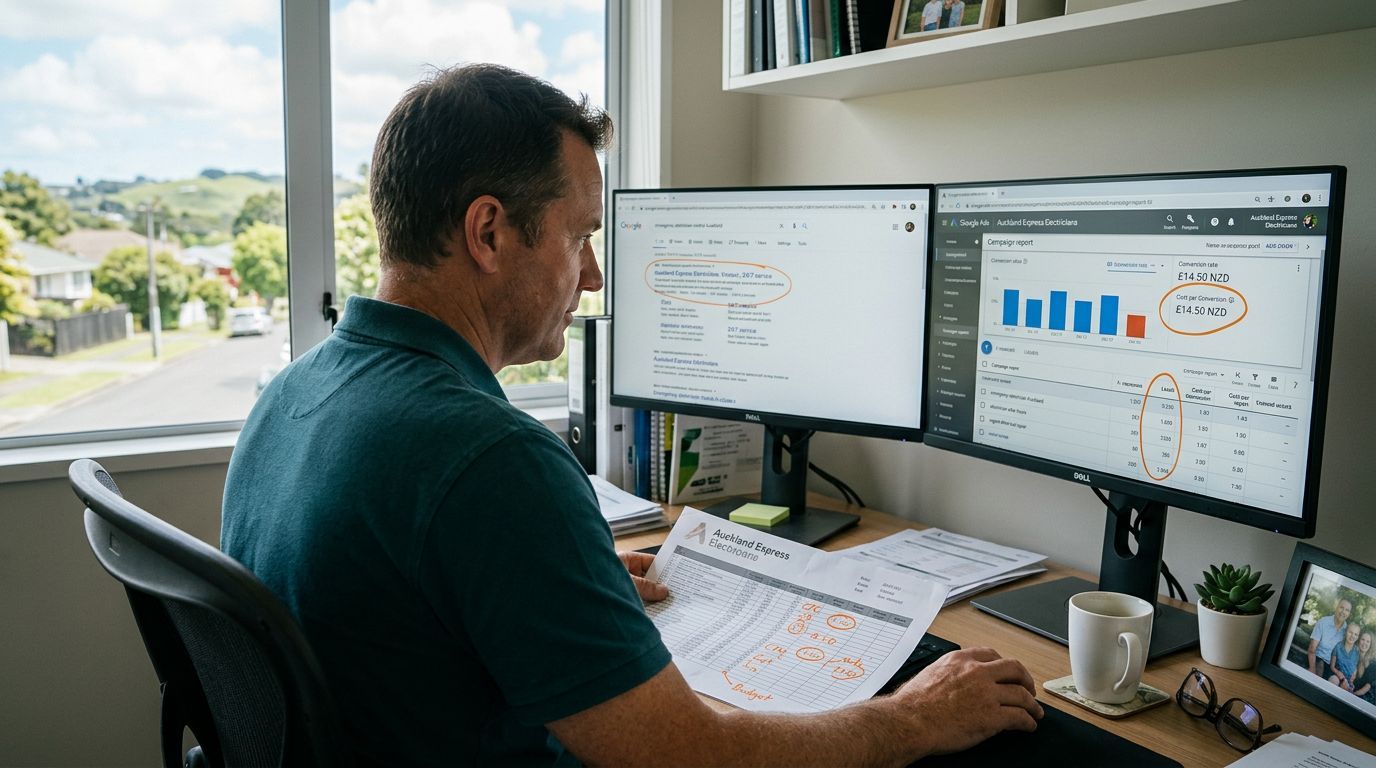
PPC stands for Pay-Per-Click. This is a model where you only pay when someone actually clicks on your ad. The most common form of this is search advertising, primarily through Google Ads. When a potential customer searches for a specific service, like "emergency electrician Auckland," your ad appears at the very top of the results. This captures people exactly when they are looking to buy. We often describe this as capturing "high-intent" traffic. If you are new to this concept, our article on The Basics: Google Advertising breaks down how it works in plain English.
Search advertising remains a powerhouse for conversion. Data from Shopify shows that the average PPC conversion rate for Google Ads is 7.52 percent across all industries. A conversion rate is the percentage of people who take a desired action, such as filling out a contact form or making a purchase, after clicking your ad. With Google holding over 79 percent of the global search engine market share, it is a critical channel for businesses that need to be found the moment a customer has a problem to solve.
Social Media Advertising
Social media advertising works differently. Instead of waiting for someone to search for you, you place your brand in front of people based on their interests, demographics, and online behaviours. This is excellent for brand awareness and reaching people who might not even know they need your product yet. Platforms like Facebook, Instagram, and TikTok allow for incredibly specific targeting. You can show your ads to people who live in a certain suburb, fall within a specific age bracket, and have shown an interest in topics related to your business.
The effectiveness of this channel is well-documented. For small to mid-sized businesses, the average ROAS for Facebook and Instagram campaigns is 4:1. ROAS stands for Return on Ad Spend, which means for every one dollar you spend, you get four dollars back in revenue. This statistic, sourced from Socioapt, highlights why so many Kiwi businesses are increasing their social media budgets. It is a powerful way to build a community and influence purchasing decisions over time.
Comparing PPC and Social Ads: Intent vs. Discovery
The choice between PPC and social ads often comes down to the "why" behind the customer's action. PPC is driven by intent. The user has a specific need and is actively looking for a solution. This makes PPC ideal for service-based businesses or companies selling products that people search for by name. If your car breaks down in Hamilton, you aren't going to scroll through Facebook looking for a mechanic: you are going to search for one on Google. Being the top result can capture more than 30 percent of that search traffic, and our managed Google Ads campaigns are designed to get you there quickly.
Social media advertising is driven by discovery. Users are on these platforms to be entertained or to connect with friends, not necessarily to shop. However, 54 percent of social media users research products on these platforms before buying. An engaging video ad or a beautiful image can stop the scroll and introduce your business to a new audience. While the average conversion rate for Facebook Ads is 7.72 percent, which is slightly higher than Google Ads, the "temperature" of the lead might be different. A search lead is often ready to buy right now, while a social lead might need more nurturing through content marketing and retargeting.
We have seen the best results when businesses use a mixed approach. You might use Google Ads to capture the immediate "I need this now" customers while using Meta ads (Facebook and Instagram) to stay top-of-mind for people who fit your ideal customer profile. This creates a balanced digital advertising strategy that covers all stages of the marketing funnel.
Realistic Budgeting for New Zealand Small Businesses
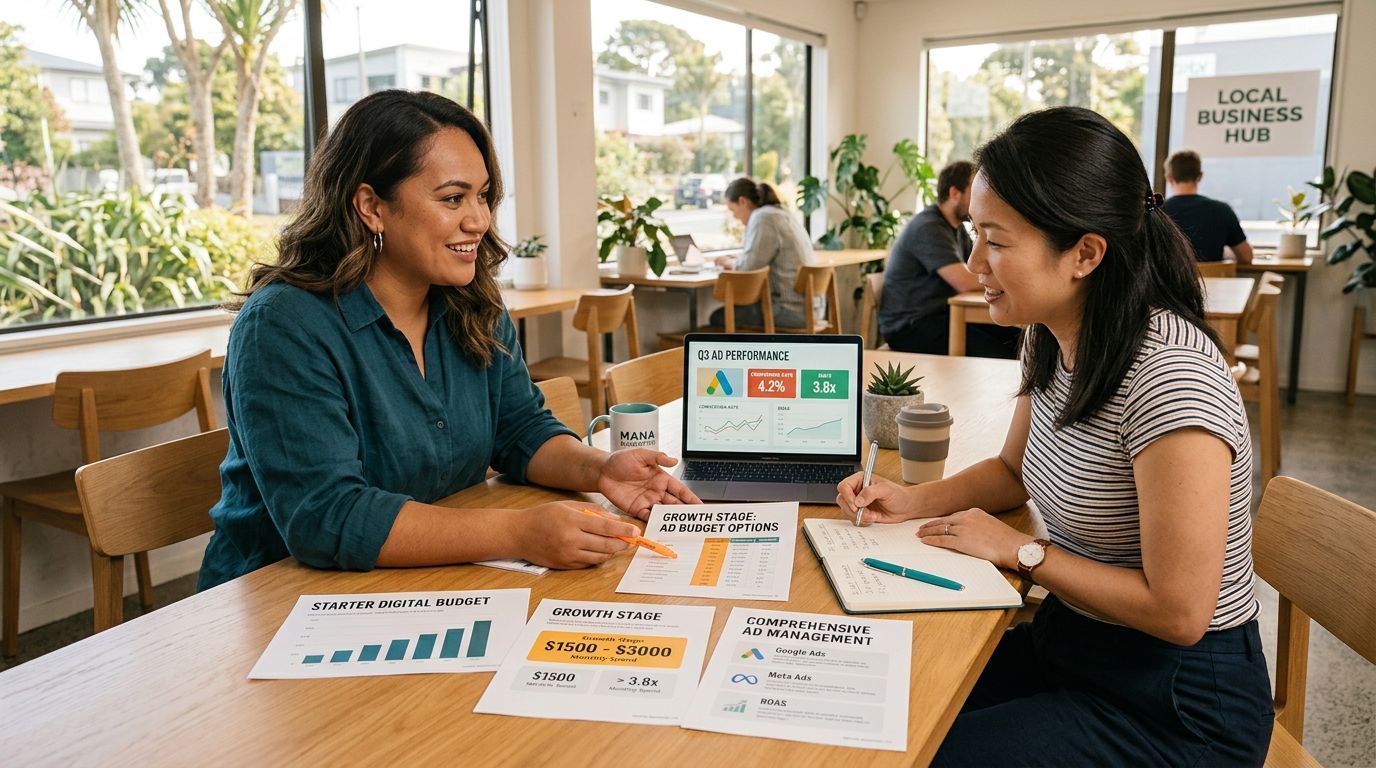
One of the most common questions we get is: "How much should I actually be spending?" It is easy to feel like you need a massive budget to see results, but that is not the case. In the New Zealand market, we recommend starting with a focused budget rather than spreading your spend too thin across every available platform. According to a 2026 NZ digital marketing guide, most small businesses should allocate between 5 percent and 12 percent of their gross revenue to marketing, with 60 percent to 80 percent of that going toward digital channels.
For a performance channel like Google Ads or Meta Ads, you should expect to invest at least $1,000 per month in ad spend, plus management fees, to generate enough data for effective optimisation. Optimisation is the process of refining your ads based on performance data to get better results over time. If you are just starting out, a starter digital budget of $500 to $1,500 per month can work well for one or two core channels. As your business grows, you might move into a growth stage where you invest $2,000 to $5,000 per month to scale your reach.
We understand that every dollar counts for a small business. That is why we offer tiered online advertising packages that are designed to be low-risk and scalable. We want to help you tap into the 4:1 ROAS benchmarks seen globally without the stress of managing complex ad platforms yourself. Our pricing is transparent and designed to fit different stages of business growth.
- Google Smart Campaign: This is our entry-level option, perfect for new businesses. It was $374 and is now $260 + GST.
- Step Up Managed Ads: Our most popular package includes monthly optimisation and has the ad budget included. It was $749 and is now $521 + GST.
- Comprehensive Ad Management: For businesses wanting expanded reach and more clicks, this starts from $739 + GST, down from $1,062.
By choosing a managed service, you ensure that your budget is being spent on the right keywords and the right audiences. A common mistake we observe is business owners setting up a campaign and then leaving it to run on "autopilot," which often leads to wasted spend on irrelevant clicks. Professional management involves constant monitoring and tweaking to ensure your cost per lead stays as low as possible.
Common Pitfalls in Digital Advertising
Even with a good budget, there are several traps that can hinder your advertising effectiveness. One major issue is a poor landing page. A landing page is the specific page a user arrives at after clicking your ad. If your ad promises a "20 percent discount on lawn mowing" but the link takes them to a generic homepage, the user will likely leave. Your landing page must be relevant, load quickly, and have a clear call to action.
Another pitfall is failing to track conversions properly. If you don't know which ads are leading to phone calls or sales, you cannot know which parts of your ad campaign are working. We prioritise measurability in everything we do. We want you to see exactly how your investment is translating into business growth. Whether it is through Google Ads or social media platforms, data should drive every decision you make.
Finally, many businesses give up too early. Digital advertising requires a period of testing and learning. The first month is often about gathering data to see what resonates with your target audience. In our experience, campaigns that are allowed to mature and are regularly optimised perform significantly better than those that are toggled on and off frequently. Consistency is key to building brand awareness and achieving a steady lift in sales.
Taking the Next Step After Your Website Launch
Your website is a powerful tool, but it needs a steady stream of visitors to be effective. Online advertising is the fastest way to get in front of customers while your organic search presence (SEO) builds up over time. By combining the high-intent reach of PPC with the broad discovery potential of social media, you create a resilient marketing strategy that works for your business 24/7.
If you are ready to move from theory into action, we are here to help. We provide straightforward, honest advice and managed solutions that take the guesswork out of digital advertising. For a deeper walkthrough of what to do once your site is live, check out our guide: Your New Website is Live. Now What? An Introduction to Online Advertising.
We support New Zealand businesses nationwide, from Auckland to Dunedin, helping them rank higher and convert more visitors into customers. Treating your advertising as a direct path to growth is the key to unlocking its value. Whether you are looking for a simple Google Smart Campaign to get started or a comprehensive management plan to scale your results, we have an option that fits your budget and your goals. Let's work together to make your online presence a success.